

Most people don’t realize their teeth have shifted until they catch a side-angle photo or a hygienist mentions crowding at the bottom. Then it stays in the back of your mind. You wonder if it’s worth fixing, how much it costs, and whether you really need a full set of braces in your thirties.
The good news is that you have more options than you did even five years ago. Some are fast. Some are invisible. Some don’t move the teeth at all and only disguise them. This guide explains the six best ways to fix crooked teeth, what each one does, who it suits, and where the trade-offs are.
Quick Answer
To fix crooked teeth, you can use Invisalign (clear aligners), traditional metal or ceramic braces, Fast Braces, dental veneers, composite bonding, or a retainer for minor relapse cases.
The right option depends on the severity of the crowding, your age, your budget, and whether you want to move the teeth or only improve their appearance.
Why Teeth Become Crooked in the First Place?
Crooked teeth aren’t always a childhood problem. Adult teeth can shift, too. The lower front teeth, in particular, tend to crowd as you age, partly because the jaw narrows slightly and partly because of pressure from the tongue, lips, and existing bite.
Common causes include genetics, jaw size versus tooth size, thumb sucking or prolonged pacifier use in childhood, mouth breathing, tongue thrust habits, early loss of baby teeth, and wisdom teeth pushing on the bite as they erupt. Some people had braces as teens but stopped wearing their retainer, allowing the teeth to slowly drift back. That’s one of the most common reasons adults ask about treatment.
Crooked teeth aren’t just cosmetic. Crowding makes flossing harder, which can increase the risk of cavities and gum disease. An uneven bite can also cause jaw pain, uneven wear, and headaches over time. For a deeper look at the bite-health side, here’s what misalignment can do to your bite.
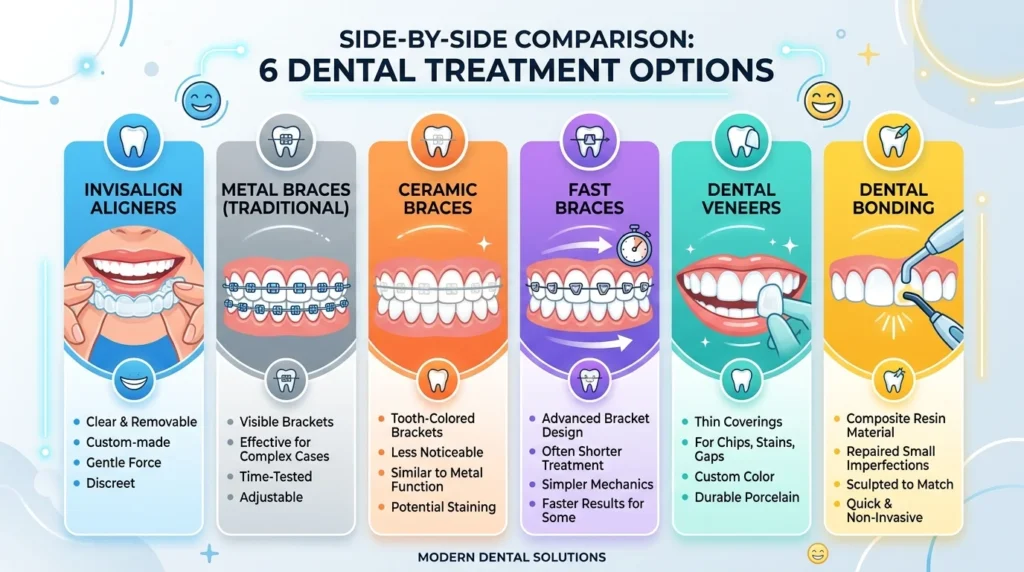
The 6 Best Ways to Fix Crooked Teeth
Here’s how the main options actually compare, from full orthodontic correction to cosmetic shortcuts.
1. Invisalign (Clear Aligners)
Invisalign uses a series of clear plastic trays that gradually shift your teeth, usually with one tray changed every one to two weeks. You wear each tray for 20 to 22 hours a day, removing them only to eat, drink anything other than water, and brush.
It works well for mild to moderate crowding, spacing, mild rotations, and some bite issues. For severe rotations or skeletal bite problems, traditional braces are often the better option.
The biggest benefit isn’t just the appearance. It’s the lifestyle fit. You can remove them for a wedding, job interview, or dinner. The main drawback is discipline. If you don’t wear them enough, treatment can stall. Most patients finish in 6 to 18 months.
If you’re curious about the mechanics, this breakdown of how Invisalign works covers the day-to-day reality. Olive Tree Dental also offers Invisalign treatment for adults and teens.
2. Traditional Metal Braces
Traditional metal braces may be old technology, but they are still reliable. Metal brackets are bonded to each tooth and connected by a wire that is tightened every few weeks.
They can handle the toughest cases, including severe crowding, major rotations, and complex bite corrections, with predictable results.
Treatment usually takes 18 to 30 months. The main downsides are visibility, mild soreness after adjustments, food restrictions, and slightly harder cleaning around the brackets. Foods like popcorn, gum, sticky candy, and hard nuts should usually be avoided.
The upside is that metal braces are often the most cost-effective option for complex cases, and they don’t depend on patient compliance in the same way aligners do.
3. Ceramic or Clear Braces
Ceramic or clear braces work the same way as metal braces, but the brackets are tooth-coloured ceramic instead of metal. From a few feet away, most people won’t notice them.
They cost a bit more than metal braces, and the brackets are slightly more likely to chip if you bite into something hard. Treatment time is usually similar.
They are a good middle-ground option for adults who want fixed braces without compliance issues, but don’t want a mouth full of metal.
4. Fast Braces
Fast Braces use a different bracket and wire system that moves the crown and root of the tooth at the same time, rather than moving the crown first and the root later. For the right cases, this can mean a much shorter treatment window, often three to twelve months instead of two years.
It’s not right for every situation, and candidate selection matters. But for many adults dealing with crowding or rotation in the front teeth, the speed is the reason they finally choose treatment after years of thinking about it.
You can read more about the Fast Braces option if it sounds like a good fit.
5. Veneers
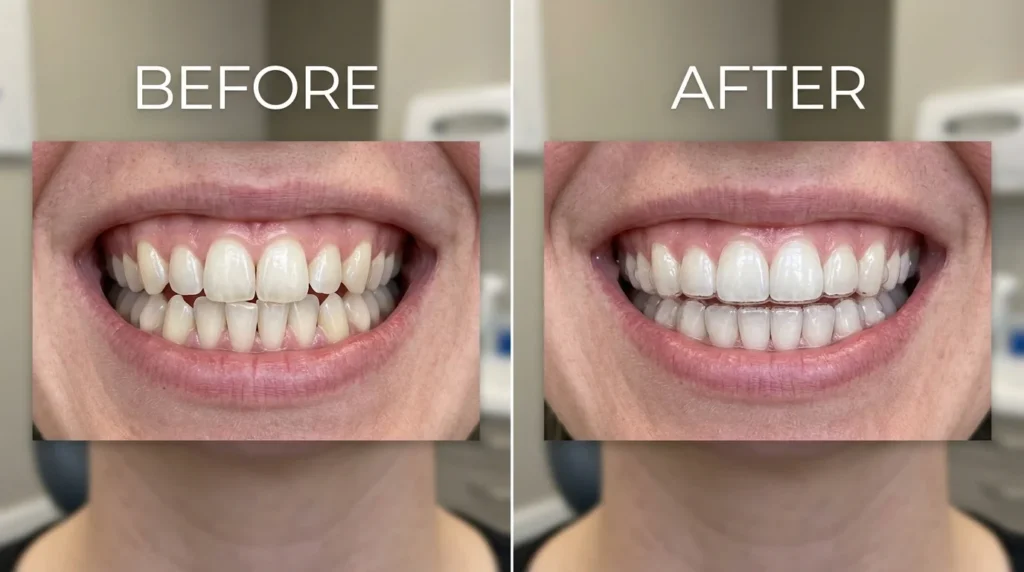
Veneers are thin shells, usually made of porcelain, bonded to the front of your teeth. They don’t move the teeth. They disguise the appearance.
This matters because veneers are a cosmetic solution for what can look like an orthodontic problem. If your teeth are mildly crooked, slightly rotated, or have small gaps, veneers can give you a straighter-looking smile in two or three appointments. They can also reshape, brighten, and even out the front teeth at the same time.
But there are trade-offs to consider. Porcelain veneers usually require some enamel removal, which is permanent. They typically last 10 to 15 years and then need replacement. They don’t fix bite problems, and they can cost more per tooth than most people expect.
For the right patient with mild aesthetic concerns and no major bite issues, veneers can be a great option. For someone with significant crowding, they are the wrong tool.
6. Composite Bonding
Composite bonding uses tooth-coloured resin to reshape teeth and fill in irregularities. Like veneers, it doesn’t move the teeth. It camouflages them.
It’s the most affordable option on this list, is often completed in a single appointment, and usually requires little to no enamel removal. The catch is that composite stains more easily than porcelain and typically lasts 4 to 8 years before needing touch-ups or replacement.
For mild crooked teeth, small chips, or closing a tooth gap, it can be a smart starting point. Many patients combine bonding or veneers with mild aligner therapy for a fuller result.
Comparison: 6 Ways to Fix Crooked Teeth
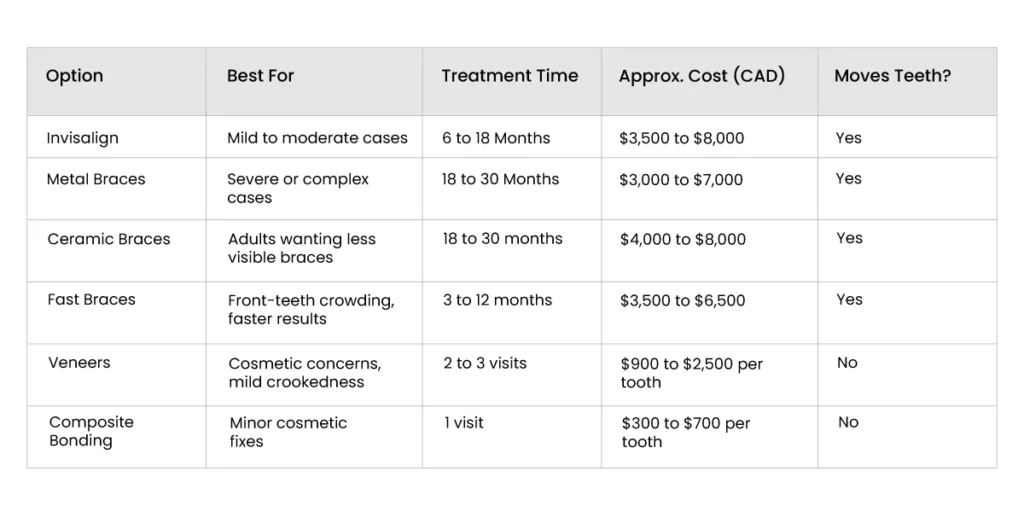
Prices vary by clinic, complexity, and province. These are typical Canadian ranges, not quotes.
Which One Is Right for You?
A few practical filters help narrow it down:
- Severity of crowding. Severe crowding or bite problems usually need braces or aligners. Veneers and bonding won’t fix structural issues; they only hide mild ones.
- Timeline. If you have a wedding in 4 months, traditional braces won’t finish in time. Bonding, veneers, or Fast Braces in some cases may be a better option.
- Budget. Bonding is the cheapest entry point. Full orthodontics is a bigger investment, but it treats the underlying problem.
- Long-term thinking. Moving the teeth fixes the root cause. Covering them treats the symptom. Both are valid, but it’s important to be clear about which one you’re choosing.
- Lifestyle. If removable trays sound like a hassle, fixed braces remove the willpower factor. If visible braces would bother you at work, aligners or ceramic braces may make more sense.
If you’d rather talk it through with someone who can look at your teeth, a cosmetic dentistry consultation gives you a clear plan based on your specific bite, not a generic list.
What to Expect at Your First Consultation
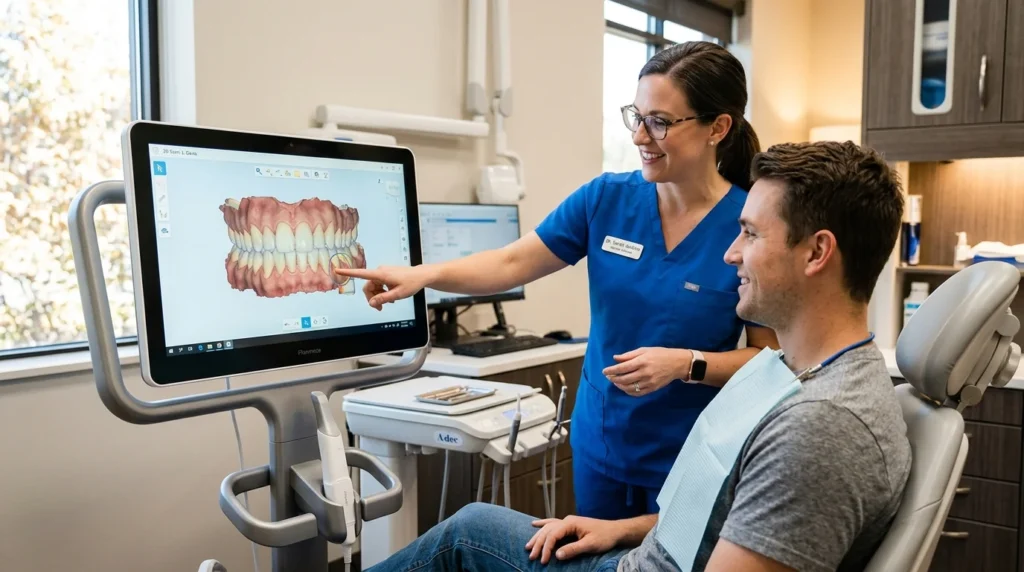
A first visit usually takes 45 to 60 minutes. The dentist will examine your bite, take photos, and often use a digital scanner, so no goopy impressions are needed at most clinics. You’ll receive a treatment plan with options, timelines, and costs in writing. There’s no pressure to start that day.
If you have questions about coverage, ask early. Most provincial plans don’t cover adult orthodontics, but private insurance often does, sometimes partially. The Canadian Dental Association has general information on dental coverage in Canada. Many clinics, including ours, offer payment plans that spread the cost over the treatment period.
Caring for Teeth After Treatment
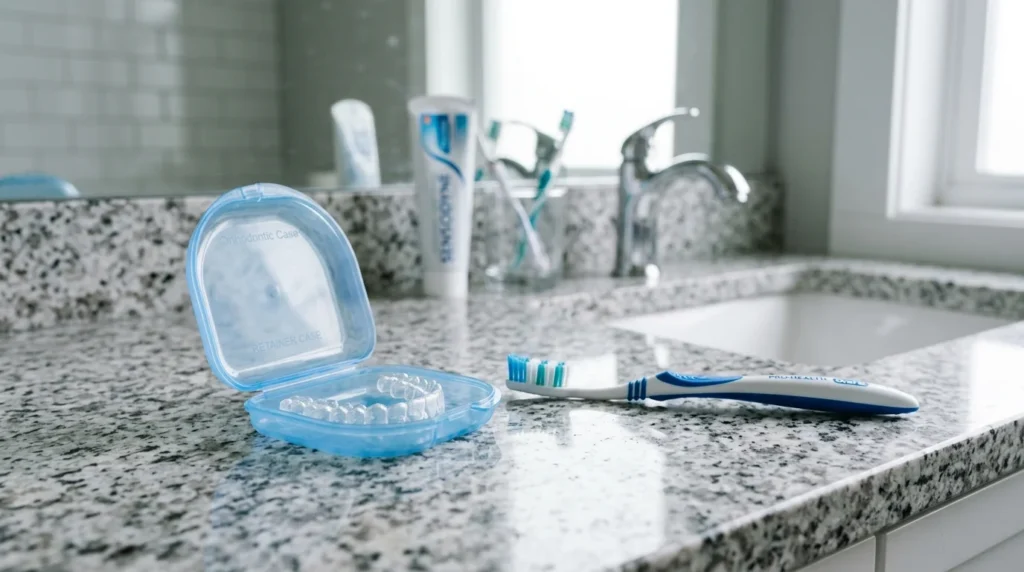
The biggest mistake adults make after orthodontic treatment is skipping their retainer. Teeth naturally want to drift back. Retainers, whether removable or a thin wire bonded behind the front teeth, help keep your investment in place. Most orthodontists recommend nightly wear long-term, sometimes for life.
If you choose the cosmetic route, such as veneers or bonding, avoid biting hard objects directly with the front teeth. Don’t open packages with your teeth or chew pen caps. Brush gently with a non-abrasive toothpaste.
Research on the long-term effects of malocclusion on oral health shows why correction and retention both matter.
The Bottom Line
There’s no single best way to fix crooked teeth. There’s a best way for your teeth, timeline, and budget.
Moving the teeth with braces, Invisalign, or Fast Braces addresses the root problem. Cosmetic options like veneers and bonding work well for mild cases but don’t fix what’s underneath.
The right answer usually comes from an honest conversation with a dentist who can assess your specific situation.
If you’ve been putting it off, a consultation is the easiest first step. To explore which option fits your bite, book a visit with Olive Tree Dental in London, Ontario, and we’ll walk you through what’s realistic for your case.
Reviewed by the clinical team at Olive Tree Dental. For personalised advice, book a consultation with our team.
Frequently Asked Questions
No. Teeth don’t straighten on their own. In adults, they usually drift further out of alignment over time, especially the lower front teeth. The jaw can narrow slightly with age, and gradual crowding is one reason patients in their 30s and 40s notice changes, even if their teeth were straight as teenagers. Active treatment is required to correct it.
Not at all. Adults make up a growing share of orthodontic patients. Bone remodelling slows with age, so treatment can take a bit longer than it does for teens, but the results can still be predictable.
The main consideration is gum health. If you have active gum disease, it should be stabilised before any tooth movement begins.
The main consideration is gum health. If you have active gum disease, it should be stabilised before any tooth movement begins.
Most patients describe pressure and tenderness rather than pain, especially in the first few days after starting treatment or after adjustments. With Invisalign, soreness usually peaks for 1 to 2 days when you change to a new tray.
Veneers and bonding can cause mild sensitivity for a few days. Over-the-counter pain relief is enough for most people.
Veneers and bonding can cause mild sensitivity for a few days. Over-the-counter pain relief is enough for most people.
Costs vary depending on the option. Composite bonding starts around $300 per tooth. Invisalign and braces typically range between $3,000 and $8,000 for a full case. Porcelain veneers can cost $900 to $2,500 per tooth.
Provincial coverage for adult orthodontics is rare, but many private insurance plans cover a portion. Most clinics offer payment plans.
Provincial coverage for adult orthodontics is rare, but many private insurance plans cover a portion. Most clinics offer payment plans.
Orthodontic results can last a lifetime if you wear your retainer. Without it, teeth can shift back, sometimes within a year.
Veneers usually last about 10 to 15 years before needing replacement. Composite bonding usually lasts 4 to 8 years. Regular cleanings and good home care can extend the lifespan of cosmetic work.
Veneers usually last about 10 to 15 years before needing replacement. Composite bonding usually lasts 4 to 8 years. Regular cleanings and good home care can extend the lifespan of cosmetic work.