Myofunctional Therapy in London, Ontario

If a dentist, orthodontist, or sleep professional has told you that you or your child has tongue thrust, mouth breathing, or a tongue tie requiring follow-up, myofunctional therapy in London, Ontario, is often the next recommended step. It is a guided program of simple exercises that retrain how the tongue, lips, and facial muscles rest, swallow, and breathe. At Olive Tree Dental in downtown London, we use it on its own and alongside orthodontic and tongue tie care, depending on what you actually need.
Here is the honest version up front. This is not a quick fix and it is not a gadget. It is practice. The exercises take a few minutes a day, you do most of them at home, and results build over months, not weeks. When you stick with it, it can make a real difference to how your mouth works.

What Myofunctional Therapy Actually is?

Your tongue has a resting place. Ideally it sits gently against the roof of your mouth, your lips stay closed, and you breathe through your nose. When that posture is off, the muscles of the mouth and face start working in ways that can affect chewing, swallowing, speech, breathing, and even how the face and jaw develop over time. That pattern has a name: an orofacial myofunctional disorder, or OMD.
Myofunctional therapy (you may also see it written as orofacial myofunctional therapy, or OMT) is a set of targeted exercises that retrain those muscles. The goal is simple to say and harder to do: get the tongue resting in the right place, get you swallowing properly, keep the lips closed at rest, and get breathing happening through the nose. It works for children and adults, because the muscles can be retrained at any age.
Want the longer background on the science and the conditions it addresses? Our guide on what myofunctional therapy is used for goes deeper. This page is about getting it done here in London.

Signs You or Your Child May Have an OMD

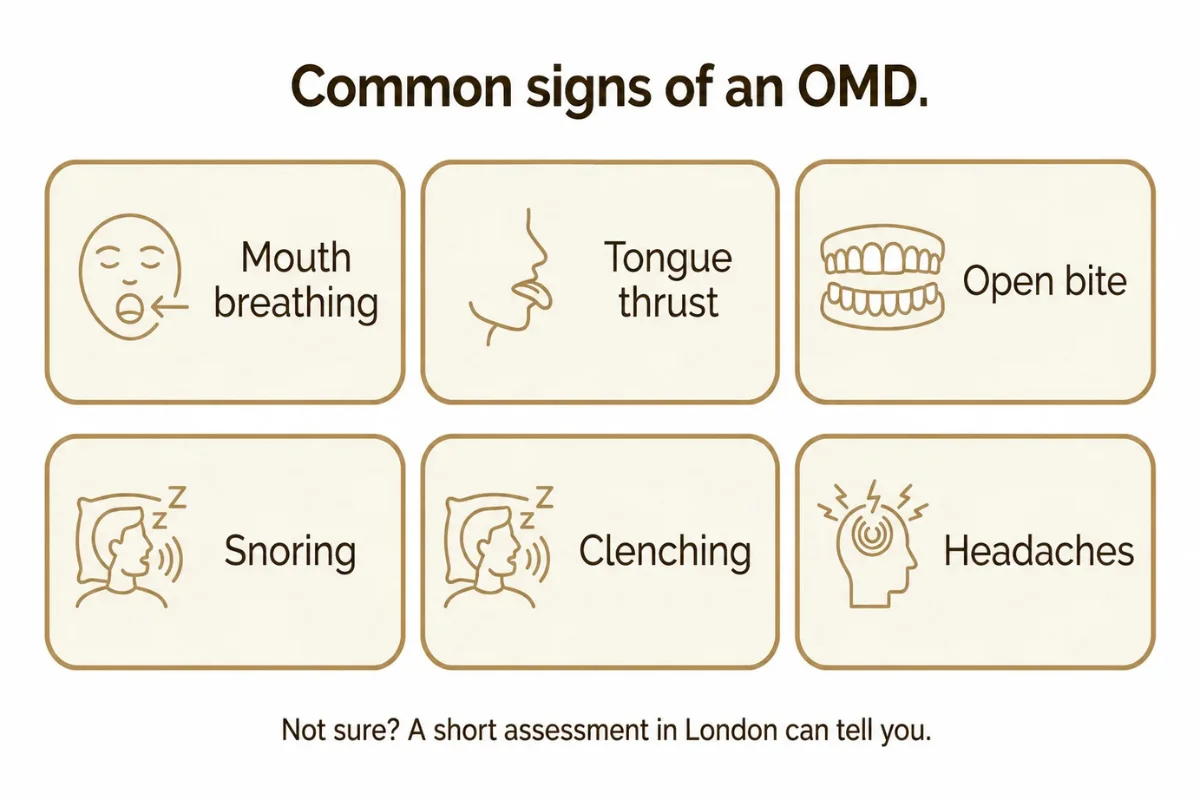
Most people come to us after someone else flags it, but these are the patterns that point to an orofacial myofunctional disorder:
You do not need every box ticked. If a few of these sound familiar, it is worth an assessment.

How Myofunctional Therapy Works at Olive Tree Dental

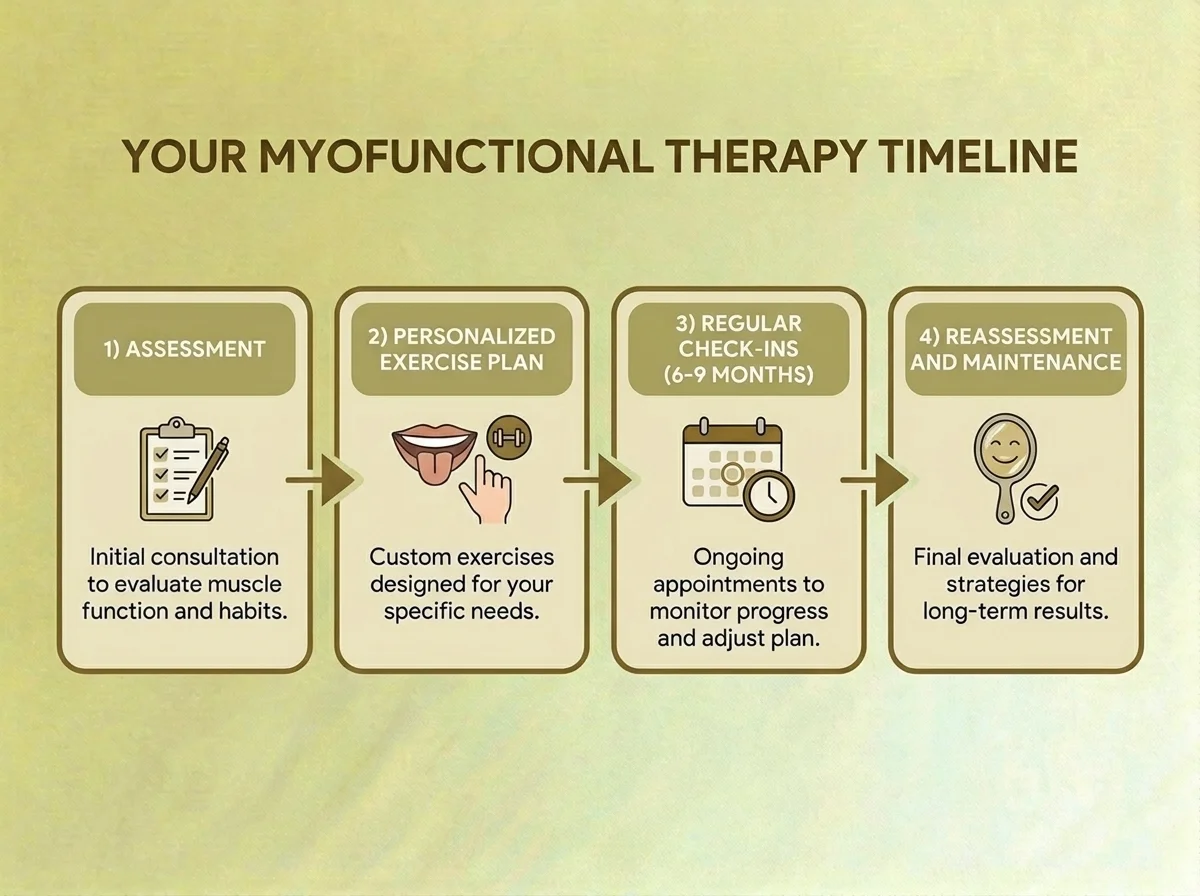
It starts with an assessment, not a program you sign up for blindly. A 60- to 90-minute first appointment includes intake questions and an evaluation of how you rest, swallow, and breathe. From there, the provider builds a plan around what your muscles are actually doing, not a one-size-fits-all template.
A typical plan includes:
The honest part: the appointments matter, but your home practice is where the change happens. Consistency beats intensity every time.

What It Can Help with, Honestly?

Myofunctional therapy in London, Ontario, has good evidence behind it for some things and a supporting role in others. Here is the straight version:
If any of that does not fit your situation, we will say so at the assessment rather than sell you a program you do not need.
Myofunctional Therapy

Benefits of Myofunctional Therapy

Myofunctional therapy is a minimally invasive treatment that involves several therapeutic exercises that can be performed in a matter of minutes. People can execute these exercises while doing their daily routine tasks. These exercises help people of any age to correct their orofacial disorders and show results within a few months, but consistency in performing them is key. Myofunctional therapy has multiple benefits, including:

1. Quicker Results

Myofunctional therapy eliminates the need for prolonged wear of traditional braces to correct oral problems. In addition, it can facilitate the use of removable orthodontic methods, such as clear aligners, by improving mouth support. Clear aligners, such as Invisalign, not only have better aesthetics, but can also be quicker than traditional braces, especially when used in conjunction with myofunctional therapy.

2. Sleep Apnea Relief

Sleep apnea is a prevalent disorder that disrupts the sleeping pattern of millions of people. If left untreated for extended periods, it can lead to various health issues such as heart stroke, high blood pressure, and more. Myofunctional therapy increases the strength of the mouth, tongue, and neck, which can prevent the collapse of throat muscles and keep the airway open during sleep.
Myofunctional therapy can strengthen the muscles of the throat, soft palate, and tongue, thereby reducing the symptoms of sleep-disordered breathing and improving mild to moderate orofacial disorders. Additionally, it may prevent the relapse of sleep apnea after surgical treatment.

3. Effective for Everyone

Myofunctional therapy is beneficial for people of all ages, unlike braces, which are more effective for children and teenagers. Our bodies are constantly changing, and the jawbone is one of the most dynamic bones. Myofunctional therapy can correct oral disorders and prevent functional problems in the jaw. This treatment is particularly advantageous for adults, as it allows everything to work properly, regardless of their age.

What a Course of Therapy Looks Like?

Most programs run about 6 to 9 months, with a series of sessions spaced out over that time and short daily exercises in between. Some people need fewer sessions, some more, depending on the issue and how consistent the home practice is. You should start to notice changes within the first few months if you are doing the work.

Cost and Insurance in London, Ontario

Straight talk on price, because nobody else local puts it on the page. Myofunctional therapy is billed as a program, not a single visit.
On insurance, here is the part most people get wrong. Many extended health plans do not list “myofunctional therapy” by name. Coverage often depends on who provides it and how the receipt is coded, and some plans reimburse related care under speech therapy. Bring your plan details to the assessment and we will help you figure out what applies.
We will always tell you what something costs before we start.

Why Patients Choose Olive Tree Dental?

We are a single location practice in the heart of downtown London, at the corner of Richmond and Oxford, and we have looked after families here for years. A few things patients tell us matter:

Ready to find out if it is right for you?

The simplest next step is a short assessment. We will look at how you rest, swallow, and breathe, tell you honestly whether myofunctional therapy would help, and lay out what it involves.
Book a consultation or call (519) 672-0931. We are at 759 Richmond St, London, ON, and we serve London and the surrounding area.

Frequently Asked Questions

Common signs are mouth breathing or lips that sit open at rest, a tongue that pushes against the teeth when you swallow, snoring or restless sleep, and clenching or jaw tension. You do not need all of them. If a few sound familiar, a short assessment can tell you for sure, and it is better to check early than to let the pattern settle in.
Most programs run about 6 to 9 months, often somewhere in the range of 10 to 18 sessions, with short daily exercises in between. The exact number depends on the issue and on how consistent your home practice is. We give you a clear estimate after the assessment rather than a guess before it.
It can help reduce the severity of snoring and mild to moderate obstructive sleep apnea by strengthening the tongue and throat muscles, but it works as part of a wider plan, not as a cure on its own. If sleep apnea is suspected, the first step is proper diagnosis, often with a sleep physician. We will point you in the right direction if that is needed.
Both. The muscles can be retrained at any age, so adults respond to therapy too. It is often especially useful for adults who want to support orthodontic treatment or reduce the chance of teeth shifting back after braces or aligners.
Sometimes, and it depends on your plan and on who provides the therapy. Many plans do not list myofunctional therapy by name, but some reimburse related care under speech therapy. Bring your plan details to the assessment and we will help you work out what applies.
No. The exercises are gentle muscle and breathing drills, not anything invasive. The harder part is remembering to do them every day, which is where the results come from.