Dentures and Dental Bridges in London, Ontario

Losing a tooth changes more than how a photo looks.
You start chewing on one side. You cover your mouth when you laugh. Bread gets stuck where the gap is, and you get quietly used to it. Then a year goes by, then three, and the teeth on either side of the gap start to drift into the space because nothing is holding them where they were.
That drift is the part most people do not see coming, and it is the reason we would rather talk to you sooner than later.
At Olive Tree Dental, on Richmond Street in downtown London, we replace missing teeth with dentures and with fixed bridges. Which one is right depends on how many teeth are gone, what shape the teeth around the gap are in, what your jawbone looks like underneath, and honestly, what you can afford right now. We will show you the options, tell you what each one costs in writing, and let you decide.
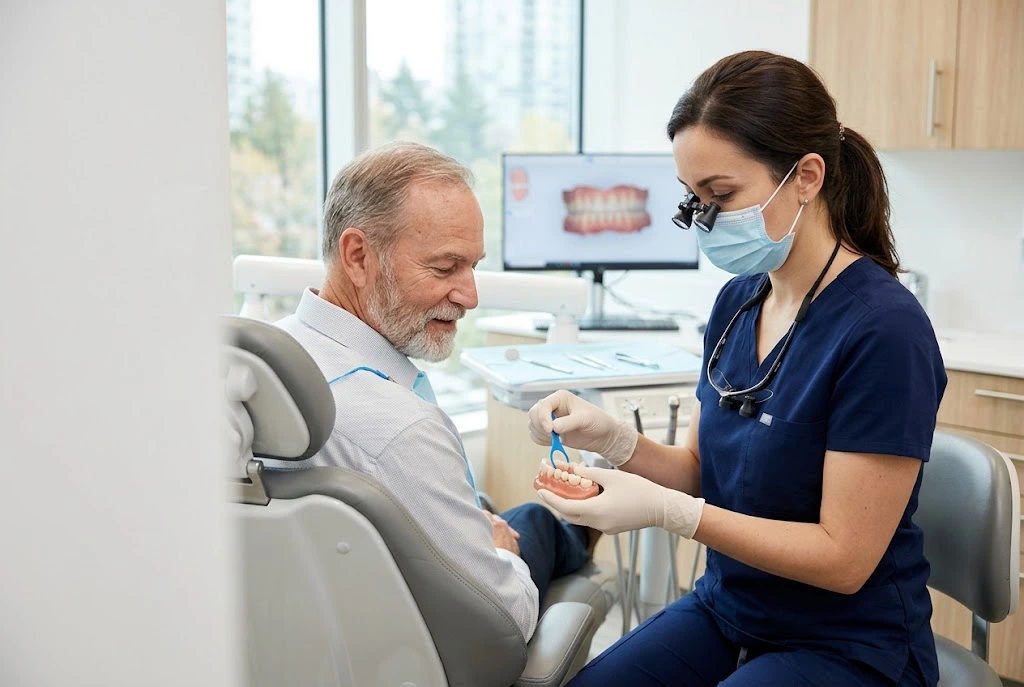
Dentures

Which option is right for you?

There is no universally best answer here. There is only the one that fits your mouth and your budget. Here is the honest version.
A dental bridge fills a gap by anchoring to the teeth on either side of it. Those neighbouring teeth (we call them abutments) get shaped down, and a single piece with crowns on each end and a replacement tooth in the middle gets cemented on top. It is fixed. You do not take it out. You clean under it with a floss threader or a water flosser.
A partial denture replaces some of your teeth while your remaining natural teeth stay put. It clips in and comes out for cleaning.
A complete denture replaces a full upper or lower arch when there are no teeth left to build on.
An implant-retained denture uses a small number of implants as anchors so the denture snaps into place and stops moving around. It costs more, but for a lower denture that will not stay put, it is often the thing that actually solves the problem.
A bridge tends to suit you if you are missing one tooth, or two in a row, and the teeth on either side are healthy and stable. A partial tends to suit you if you are missing several teeth spread around the arch. A complete denture is for a full arch.
One trade-off worth knowing before you decide: to fit a conventional bridge, we have to reduce the two healthy teeth on either side of the gap. They are being permanently altered to carry the bridge. If those teeth are pristine, some people would rather not touch them, and an implant becomes worth a look instead. If those teeth already need crowns anyway, a bridge is doing two jobs at once and that maths starts looking very good.
We will tell you which way we would lean and why. Then it is your call.

Dentures and the Canadian Dental Care Plan

This is the part most dental websites in London have not caught up with, so it is worth being clear about.
The Canadian Dental Care Plan covers complete dentures and partial dentures. If you qualify for the CDCP, removable dentures are one of the major restorative services the plan will actually pay a portion of. For a lot of people in London who have been putting off tooth replacement for years because of cost, this genuinely changes the arithmetic.
A few things worth knowing before you get your hopes up or write it off:
If you are on the CDCP and you have been waiting, come in and let us look. Bring your Sun Life details and we will find out exactly where you stand before we plan any treatment.

What dentures and bridges cost in London, Ontario

We do not publish a price list, and we want to explain why rather than just leave you guessing.
Two people can walk in with what looks like the same missing tooth and need completely different treatment. One has healthy bone and clean neighbouring teeth. The other has a root fragment that needs to come out first, some bone loss under the gap, and a neighbouring tooth that needs a root canal before it can carry anything. Quoting them the same number would be dishonest to one of them. So we give you a written, itemised estimate after we have actually looked, and we do not start until you have seen it and said yes.
What we can give you is honest market context, so you know roughly what world you are in.
Ontario market ranges (general context, not our fees):
Treatment Typical Ontario range Notes
Complete denture, per arch Roughly $600 to $2,200 professional fee, plus lab fee The lab fee is charged separately and is real. Budget for it.
Partial denture (cast) Roughly $490 to $1,520 professional fee, plus lab fee Flexible and acrylic partials sit differently in the range.
Standard three-unit bridge Roughly $2,500 to $4,500 This is for one missing tooth. It is called three-unit because it is two anchor crowns plus the replacement tooth.
Denture reline Roughly $335 to $465, plus lab Needed periodically as your gums change shape.
Denture repair Roughly $105 to $305, plus lab
Implant-retained denture Typically $10,000 and up per arch Not covered by the CDCP.
Nobody should find out what their dentistry costs at the checkout desk.

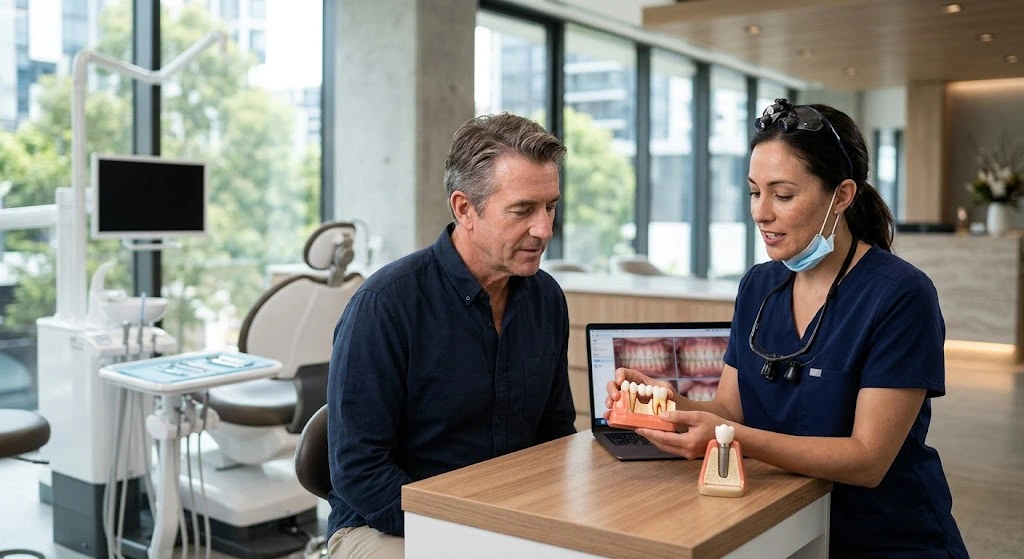
Getting a bridge

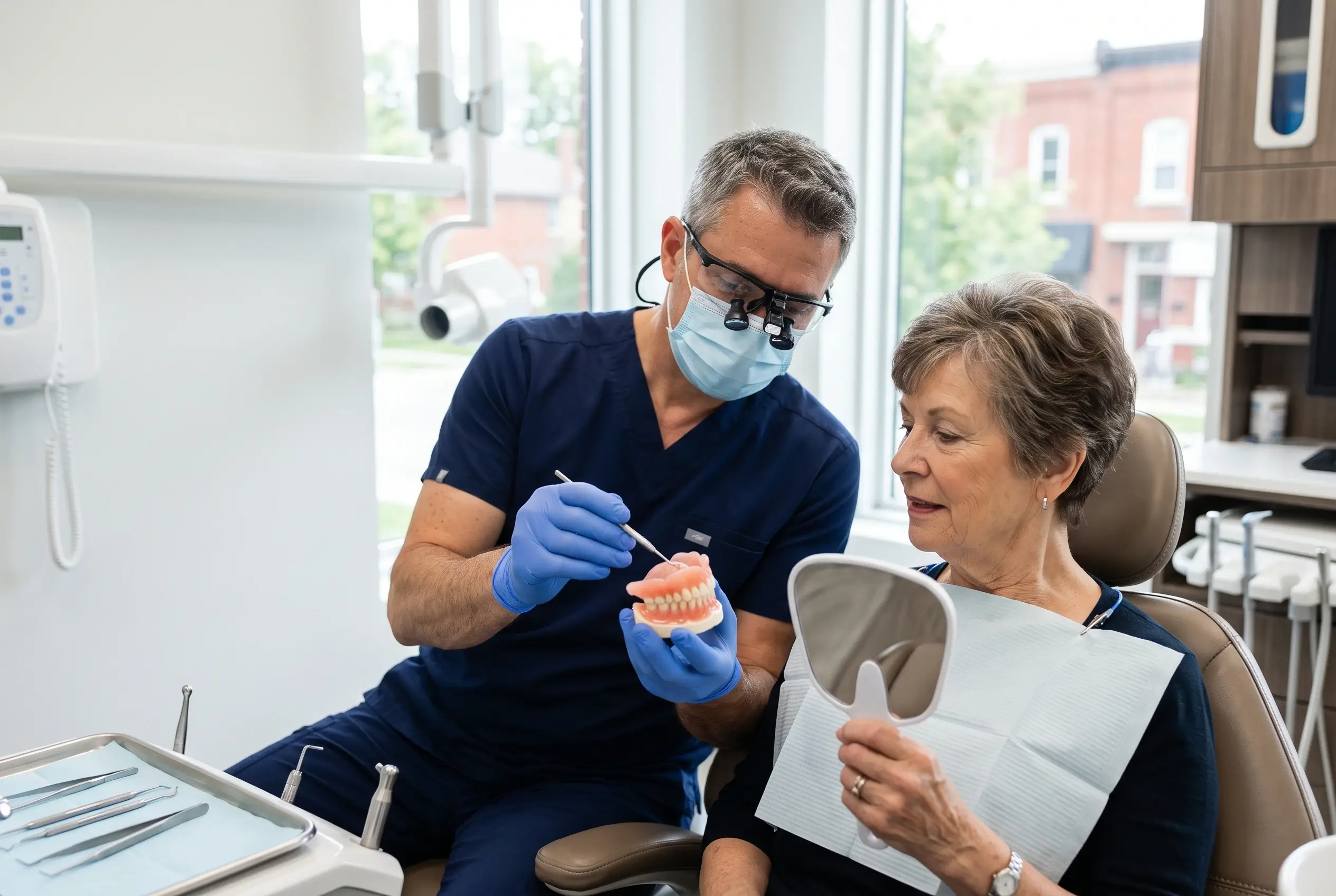
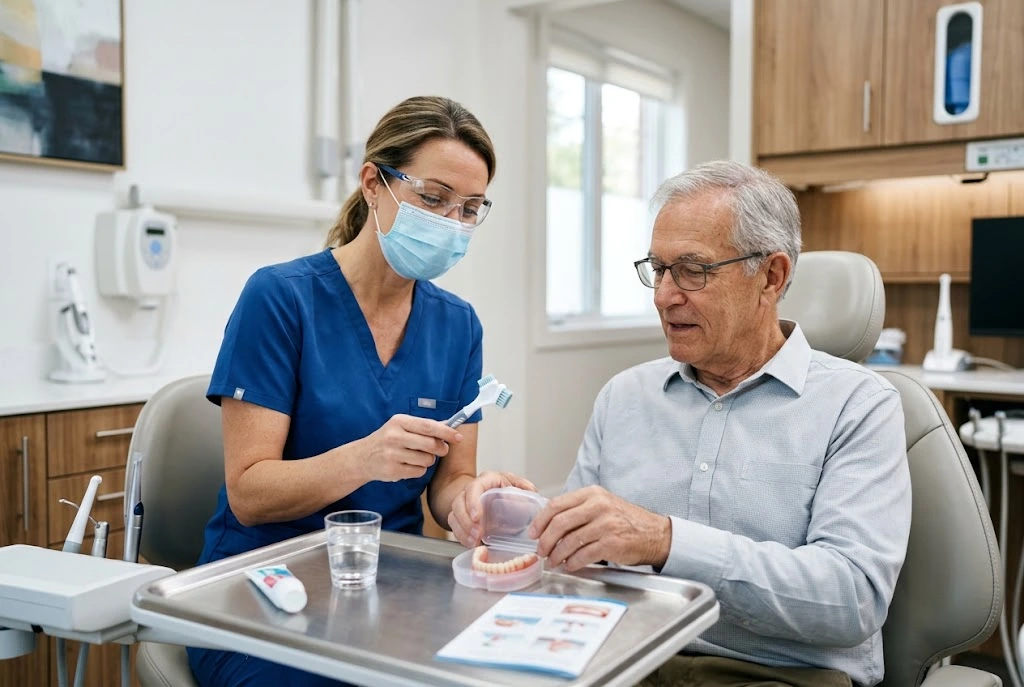
Getting dentures

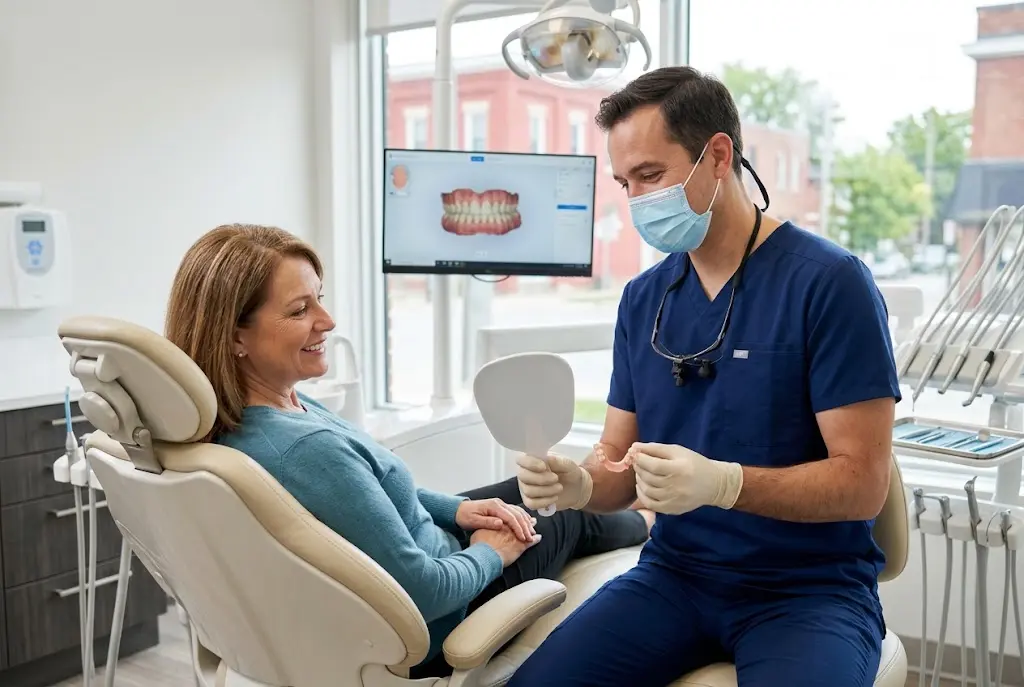
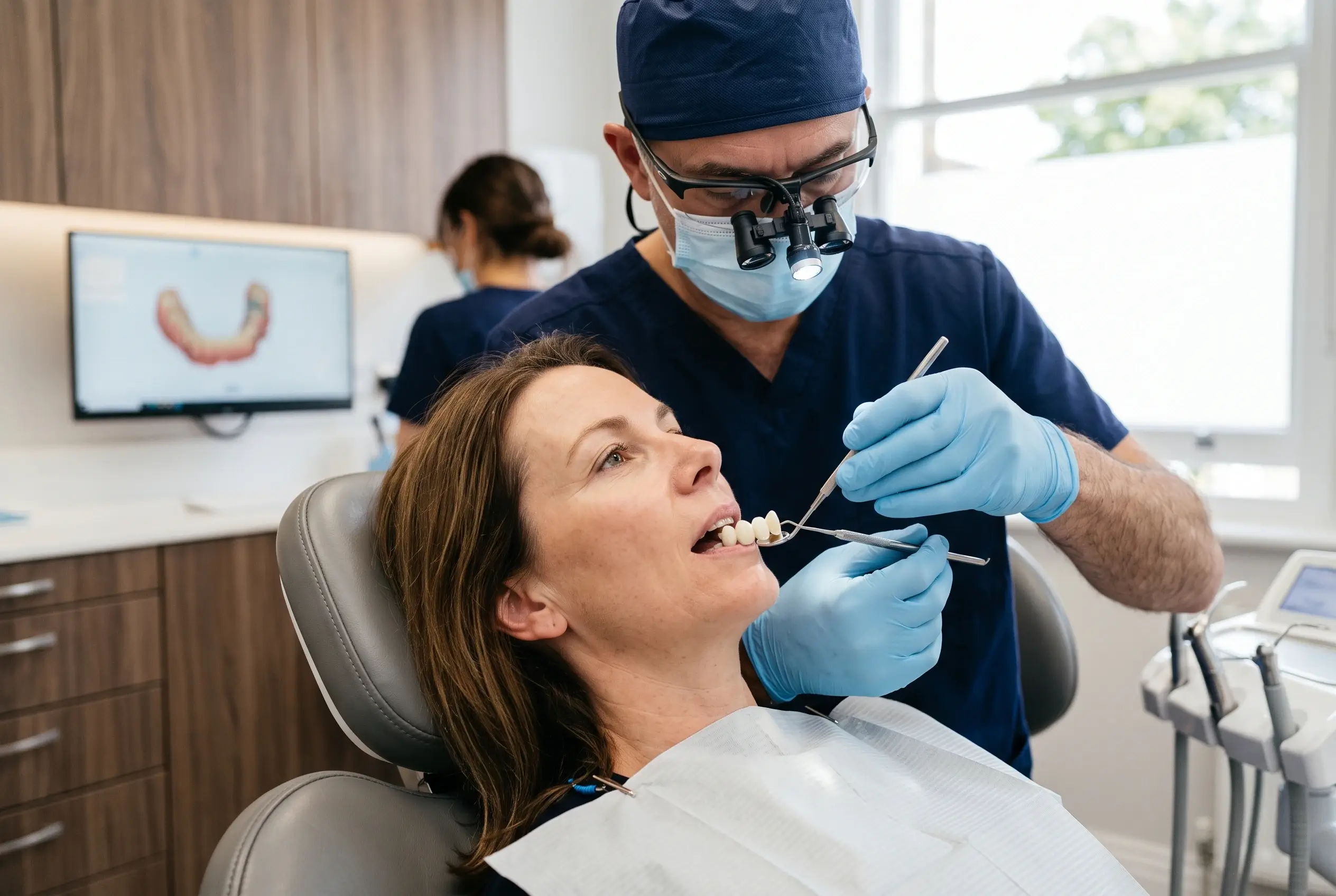
Digital dental scan being taken for a custom bridge at Olive Tree Dental in London, Ontario

Does it hurt?

Straight answer: the appointment itself should not be painful, but let us be precise about what that means, because “painless” is a word we are not willing to use.
We freeze the area, and we wait for it to actually take before we start. What you will feel during a bridge preparation is pressure and vibration, not pain. That is a strange sensation the first time, and it is worth knowing it is coming so it does not alarm you.
Afterwards, expect some tenderness. For a bridge, that is usually cold sensitivity in the anchor teeth that fades over a few days to two weeks. For dentures, it is usually sore spots on the gums that need one or two quick adjustments.
If you are anxious about dental work, say so when you book. It changes how we run the appointment. It is not a bother, and you are not the first person to say it.

Making them last

Neither of these is fit-and-forget.
A bridge does well for about 10 to 15 years with good care, and often longer. The thing that ends a bridge early is almost never the bridge. It is decay in the anchor teeth underneath it, because those teeth are still real teeth and they can still get cavities. So you clean under the pontic, with a floss threader or a water flosser, every day. That single habit is most of the game.
Dentures typically need attention every 5 to 10 years, and relines sooner than that. Your jawbone changes shape over time once the teeth are gone. The denture does not change with it. That is why a denture that fit perfectly three years ago now clicks or rocks. That is not a defect. It is your mouth changing, and it is fixable with a reline.
Take them out at night. Brush them with a non-abrasive denture cleaner, not regular toothpaste, which is more abrasive than people realise. Soak them. And keep coming in, even if you have no natural teeth left, because we are still checking the fit and still screening the soft tissue.

Why patients in London choose us for this

Twenty-five years on Richmond Street, in the same downtown London office, doing this work for the same families.
4.9 stars across more than 518 Google reviews. Named Top Choice Dental Clinic in London, Ontario five years running, 2022 through 2026.
But the reason to pick us for a denture or a bridge specifically is narrower than that: we get the fit right, and we tell you the cost up front, in writing, before we start. Prosthetic work lives or dies on those two things. A beautifully made bridge with a high bite is a failure. A denture you cannot afford to have adjusted is a denture in a drawer.
We are also a full dental practice, not a denture clinic alone. That matters more than people expect. If a tooth needs to come out first, if an anchor tooth needs a root canal before it can carry a bridge, if you decide partway through that you would rather look at implants, all of that happens in the same building, with the same team, on the same treatment plan. You are not being sent across town and starting over.

Book a consultation

If you have a gap, a denture that has stopped fitting, or a bridge that has come loose, come in and let us take a look.
Olive Tree Dental, 759 Richmond St, London, ON N6A 3H4. Downtown, at Richmond and Oxford.
On the CDCP? Tell us when you book and bring your Sun Life details. We will check your coverage before we plan anything.

Frequently Asked Questions

Yes. Complete dentures and partial dentures are both covered services under the CDCP. Coverage is not unlimited, though. The plan applies frequency limits, some denture services need preauthorization first, and depending on your household income you may have a co-payment. Implant-supported dentures are excluded entirely. Bring your Sun Life details to your consultation and we will confirm exactly where you stand before any treatment is planned.
A standard three-unit bridge, which replaces one missing tooth using the two neighbouring teeth as anchors, typically falls somewhere around $2,500 to $4,500 in Ontario. Your actual cost depends on the material, how many units you need, and whether the anchor teeth need any work before they can carry the bridge. We give you an itemised written estimate after we examine you, and you can take it to your insurer for a predetermination before you commit.
No, and be cautious of anyone who tells you they are. A bridge is fixed, which means it is cemented in place and you cannot remove it yourself. That is not the same as permanent. With good daily cleaning, a bridge commonly lasts around 10 to 15 years, sometimes longer. What usually ends one early is decay in the anchor teeth underneath, which is why cleaning under the bridge every day matters so much.
The appointment should not be painful. We freeze the area and wait for it to take effect before starting, so what you feel during a bridge preparation is pressure and vibration rather than pain. Afterwards, expect some tenderness. Anchor teeth can be cold-sensitive for a few days to a couple of weeks, and new dentures usually create a sore spot or two that we ease at a follow-up. If dental work makes you anxious, tell us when you book and we will adjust how we run the appointment.
They will feel like yours, and for most people that gets comfortable within a few weeks. But we are not going to tell you they feel and function identically to natural teeth, because they do not. Chewing is less efficient, especially at first, and you will change how you eat some things. What a good denture does is restore your bite, hold up your facial structure, and let you talk and eat and smile without thinking about it. If a lower denture will not stay put no matter what, implants used as anchors are usually the honest answer, and we will tell you that rather than keep adjusting something that cannot work.
It depends mostly on the teeth either side of the gap. If they are perfectly healthy, a bridge means grinding down two good teeth to save one, and an implant leaves them alone. If those neighbouring teeth already need crowns, a bridge does two jobs at once and often makes more sense. Implants cost more up front and take longer, usually several months, but they do not rely on the neighbouring teeth. Bridges are faster, typically two to four weeks. We will show you what we see on the X-ray and tell you which way we would lean, and why.