
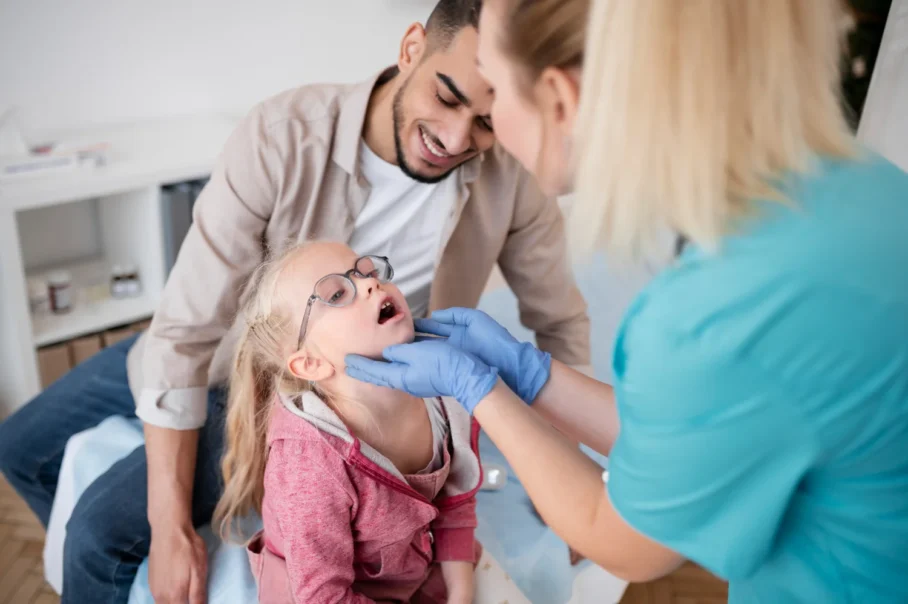
Have you ever wondered why certain sufferers struggle with snoring, chewing or speaking clearly? Orofacial myofunctional treatment could be the solution.
It’s a specific program that helps the muscles of the face and mouth to perform better. This therapy can help with issues such as breathing through the mouth, sleep apnea or even issues with speech.
This article explains the nature of orofacial myofunctional therapies, what it is, how it benefits you with exercises that are common to all, and the reason why it is important.

What Is Orofacial Myofunctional Therapy?
Orofacial myofunctional therapy, also known as OMT also known as myofunctional therapy is similar to exercise therapy that targets the face and mouth.
It involves exercises that build and strengthen muscles in the mouth, tongue cheeks, tongue, and throat. These muscles must cooperate for tasks like chewing, breathing, swallowing and speaking. If they aren’t working, issues occur, which are known as orofacial myofunctional disorders (OMDs).
These conditions occur when muscles relax or move in the wrong direction, for example, a tongue pressing against the teeth while eating.
OMT can correct these issues by implementing specific exercises, usually led by a speech therapy or dentist or professional. It’s non-invasive which means that there is no need for surgery or medication. It is suitable for children as well as teens and adults.
The aim is to allow muscles to relax and move properly to help manage conditions of health, and also improve the look of the face in the long run.
Why Muscles Matter?
- The muscles of the tongue can be weak and restrict airways, leading to snoring.
- Lip strength is not strong enough, which can lead to mouth breathing.
- Incorrect swallowing patterns impact the alignment of teeth.
- Muscles that aren't trained can cause speech problems.
- Injuries to muscles can lead to jaw pain.
Who Needs This Therapy?
OMT assists a range of people. Children who have speech difficulties such as lisping often gain from retraining their tongues. Adults suffering from sleep apnea might notice less snoring following therapy.
Patients suffering from grinding teeth or jaw pain may find relief through the use of balancing muscles. Patients who are getting braces may utilize OMT to stop the teeth shifting.
People with a tongue tie or tongue-tie, in which the tongue’s movements are limited and can be improved after surgery through these exercises.
Mouth breathing issues such as chronic chewing, thumb sucking or other problems can also be treated. Speech pathologists, commonly speech therapists or dental hygienists check for OMDs and develop an individual program.
The treatment usually lasts between six and twelve months, contingent on the condition. Sessions combine in-person visits and exercises at home to achieve lasting results.
Common Conditions OMT Helps
- Snoring and sleep apnea
- Speech issues like lisping and the stuttering
- Jaw pain or temporomandibular problems (TMD)
- Tongue-thrust when swallowing
- Breathing through the mouth chronically
- Teeth misalignment after braces
Treatment Details:
How does a session of myofunctional therapy go?
OMT is a range of exercises that improve your facial and mouth muscles. Your myofunctional therapist will develop an individual plan that is tailored to your requirements. The things you could be doing in your OMT therapy session are:
- Sing
- You can play with a wind instrument
- Do breathing exercises
- Extend or lift your tongue in certain ways
- Keep a small item between your lips
How Long Do I Have To Undergo This Treatment?
The duration of OMT depends on the issue it’s treating. Typical treatment spans from six up to twelve months. It is possible that you will require longer or shorter time, depending on your particular situation.
Your provider will explain to you the number of days each week you must attend therapy, as well as the length of each session that will be. You could attend certain sessions with your therapist and others by yourself at home.
What Kind of Practitioner Performs Myofunctional Therapy?
Healthcare professionals with specialized training in orofacial myofunctional conditions (OMDs) provide myofunctional therapy. Speech-language pathologists, occupational therapy and dental hygienists are a few examples of practitioners who undergo this training.
Some providers can earn certifications through professional organizations or the International Association of Orofacial Myology.
The certifications indicate that the provider has been through extensive training and remains up-to-date in the field through continuing education activities. Some of the credentials you can find following the name of your provider include:
- Myofunctional therapy certified by a certified orofacial therapy (COMT(r)).
- Myologist certified by the American Board of Certification (COM(r)).
The providers who specialize in OMT generally work in conjunction with other specialists such as Otolaryngologists, dental surgeons, and Sleep medicine experts. Together, they create an appropriate treatment plan to meet your specific needs.
Popular Myofunctional Therapy Exercises
Myofunctional therapy exercises focus on specific muscles to correct the bad patterns.
They’re easy, only take a few minutes a day and can be enjoyable particularly for children. The therapist customizes them according to meet the needs of each individual However, here are a few common ones usually performed with the mirror to ensure accuracy
- Tongue Push-Ups: Position the tongue's tip against the roof of your mouth, right next to those teeth in front. Press it upwards and hold it for five minutes. Repeat 10 times. This helps strengthen the tongue to help improve speech and swallowing.
- The Lip Seal holds: Place the small button or piece of paper between your lips, not the teeth for 30 minutes. Then pull gently on a string that is tied to the button to provide resistance. Repeat this five times. This helps build the strength of your lips to allow breathing through the nose.
- Tongue Slides: Push the tongue's tip against the palate, then gently slide the tongue back. Repeat this five times. This will help the tongue sit properly, and reduce airway obstruction.
- Cheek Puffing: Puff your cheeks using air, hold for 10 seconds, then let go. Repeat 10 times. This improves the muscle tone in the cheeks to improve mouth closure.
- Nasal Breathing Exercise: Close your mouth, press your tongue on the palate, and then breathe by the nostril for a minute. Repeat the exercise five times. This will increase nasal breathing and reduce sleep apnea.
When performed regularly, help to strengthen muscles over the course of months.
One kid loved playing the “tongue push-up” game, continuing to play it, and fixing the lisp after a few weeks. Always consult with a therapist to make sure you get the correct movements, since the written descriptions aren’t enough.
Benefits of Orofacial Myofunctional Therapy:
OMT could be helpful:
- Help yourself to breath through the nose, chew food and/or talk clearly.
- Improve your tongue or lip position to help support your teeth alignment and improve your oral health.
- Help you recover from jaw surgery.
- Encourage the orthodontic goals treatment.
- Find out if you require speech therapy (which is different from OMT is focused on language and speaking abilities).
- Enhance your self-confidence.
The majority of research into OMT is focused on the ways it can aid people suffering from obstructive sleep apnea. This is especially true when it is used in conjunction with other treatments for sleep apnea.
According to a study that was conducted recently there is evidence to suggest that OMT could:
- Reduce your nighttime breathing difficulties to less than
- Make you sleepy less during the day.
- Aid you to get more oxygen during your sleep.
- Reduce the frequency at which you snore.
- Provide a substitute or a supplement to CPAP use
Why OMT Matters For Overall Health?
The face and the mouth connect to the entire body. Poor muscle movements, such as breathing through the mouth, decrease the amount of oxygen in the body, which affects concentration and energy.
Sleep apnea, which is linked with weak muscles in the throat, increases the risk of heart problems or fatigue. OMDs may also cause misalignment of teeth, which can result in expensive dental treatment.
OMT treats these issues at the source by repairing muscle patterns. In the case of children, it assists in healthy jaw growth and facial development and prevents issues such as the crowded teeth. Adults have more rest and less discomfort.
One patient stopped snoring after 3 months OMT which resulted in better sleep and feeling more sharp.
OMT’s focus on nasal breathing can also help improve the health of the airways, which could aid in sinus allergies or issues. Early intervention, particularly for children, helps prevent the development of long-term problems.
How to Begin with OMT?
The process of starting OMT is easy, but requires dedication. Begin by contacting an accredited therapist to conduct an assessment.
They’ll assess muscle movement and formulate a strategy. Sessions could be in-person or online, with home exercises that are assigned. Training takes around ten minutes each day, divided into small intervals. Be consistent, as skipping days will slow the process.
Children often love the exercise including tongue clicks, whereas adults may need reminders to keep doing it. Therapy may last for up to a whole year, based on the problem.
Costs can vary, but a lot of insurance plans will cover it, particularly in the case of sleep or speech problems. Consult with your service provider for more details.
A good therapist monitors the progress of patients with measurements or photos to demonstrate improvement. Videos and online resources, such as those from clinics that are reputable, can aid in practice, but they shouldn’t be used to substitute for professional guidance.
Steps to Begin
- Find an accredited OMT therapist.
- Make an appointment for an evaluation to evaluate the muscle's habits.
- Make sure you follow the plan of exercise that you've made every day.
- Follow-up with sessions to monitor your progress.
- Be consistent and consistently practice for the best results.
Wrapping It Up
Orofacial Myofunctional therapy is an easy, efficient way to treat facial and mouth muscle issues. From snoring to issues with speech It tackles a wide range of problems with simple exercises.
If you have a child who has a lisp, or for an adult suffering from jaw discomfort, OMT can make a significant difference. Start by finding a qualified expert and adhering to the program.
Everyday efforts can make big improvements.
Do not let dental issues hinder your progress. Get started with OMT and get a better, more energised smile.