

Crooked or crowded teeth are common in both children and adults. They can affect the appearance of your smile, make brushing and flossing more difficult, and sometimes affect the way your teeth come together when you bite. Orthodontic treatment can move crooked teeth into a healthier and more comfortable position, while cosmetic treatments can improve the appearance of mildly uneven teeth.
The best treatment depends on the amount of crowding or misalignment, your bite, the health of your teeth and gums, your treatment goals and whether you need your teeth moved or simply want to improve their appearance.
At Olive Tree Dental in London, Ontario, treatment options may include Invisalign clear aligners, traditional braces, ceramic braces, Fast Braces, veneers and composite bonding.
Can Crooked Teeth Be Fixed?
Yes. Crooked teeth can often be straightened or improved with professional dental treatment.
Orthodontic treatments such as Invisalign and braces gradually move teeth into a better position. Cosmetic treatments such as veneers and composite bonding do not move the teeth; instead, they change their shape or appearance.
A dental examination is important before choosing a treatment because crooked teeth can sometimes be associated with crowding, bite problems or other dental concerns.
Why Are My Teeth Crooked?
Crooked teeth can develop for several reasons. Some people are born with a tooth or jaw structure that makes crowding more likely, while others develop crooked teeth as they grow or as their teeth shift over time.
Common causes include:
- Genetics and family history
- A mismatch between tooth size and available space in the jaw
- Crowding during tooth development
- Early loss of baby teeth
- Prolonged thumb or finger sucking during childhood
- Pacifier habits
- Tongue-thrusting habits
- Certain jaw and bite problems
- Dental injuries
- Missing teeth
- Teeth shifting after previous orthodontic treatment
Some people who had braces when they were younger notice their teeth becoming crooked again years later. This is one reason retainers are an important part of maintaining orthodontic results.
Not every case of crooked teeth has one obvious cause. Your dentist can assess your teeth, gums and bite to determine what is contributing to the problem.
Can Crooked Teeth Affect Your Oral Health?
Crooked teeth are not always a health problem. Some people choose treatment mainly because they are unhappy with the appearance of their smile.
However, crowded and crooked teeth can be more difficult to brush and floss properly. This can allow plaque to build up in areas that are harder to reach, increasing the risk of tooth decay and gum disease.
Misaligned teeth can also affect the way the upper and lower teeth meet. Depending on the type of bite problem, this may contribute to difficulty chewing, uneven tooth wear or discomfort.
If your crooked teeth are difficult to clean, affect your bite or bother you cosmetically, it may be worth discussing your treatment options with a dentist.
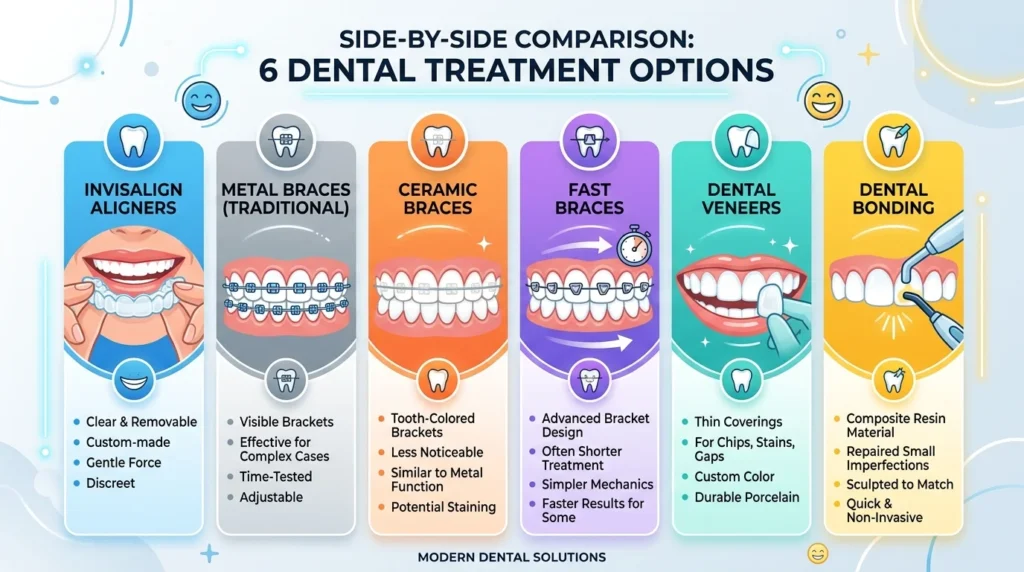
6 Ways to Fix Crooked Teeth
There is no single treatment that works best for everyone. The right option depends on how your teeth are positioned, whether your bite needs correction and whether your goal is to move the teeth or improve their appearance.
1. Invisalign Clear Aligners
Invisalign uses a series of custom-made clear aligners to gradually move the teeth. The aligners are removable, allowing you to take them out when eating, drinking, brushing and flossing.
Clear aligners may be suitable for a range of alignment and bite concerns. However, not every patient or case is suitable for Invisalign. The complexity of the tooth movement and your individual bite need to be assessed before treatment begins.
Benefits of Invisalign
- Clear and less noticeable than traditional braces
- Removable for eating and oral hygiene
- No brackets and wires
- Easier to brush and floss than with fixed braces
- Can be used for many adult and teen cases
- Treatment is planned specifically for your teeth
Invisalign treatment starts with an assessment and digital planning. Your dentist can determine whether clear aligners are suitable for your teeth and show you what treatment may involve. Invisalign also notes that treatment time varies according to the complexity of the case, with some patients beginning to see changes within several months.
Important: Invisalign is not simply a cosmetic cover for crooked teeth. The aligners apply controlled forces to move teeth into new positions.
2. Traditional Metal Braces
Traditional braces remain an effective option for straightening crooked and crowded teeth.
Small brackets are attached to the teeth and connected with orthodontic wires. The wires apply controlled pressure that gradually moves the teeth.
Metal braces may be considered when a patient needs more comprehensive tooth movement or bite correction. They are fixed to the teeth throughout treatment, so you do not have to remember to wear them each day.
Benefits of metal braces
- Effective for many types of tooth misalignment
- Can address crowding and spacing
- Can be used for bite correction
- No daily wear-time decision as with removable aligners
- A well-established orthodontic treatment
You may experience some soreness after adjustments, and cleaning requires extra care around the brackets and wires. Treatment length varies depending on the individual case.
The Canadian Dental Association notes that orthodontic treatment can take months or years depending on the problem being corrected.
3. Ceramic or Clear Braces
Ceramic braces work in a similar way to traditional braces, but use tooth-coloured or clear brackets that are less noticeable.
They can be an option for adults and others who prefer fixed braces with a more discreet appearance.
Benefits of ceramic braces
- Less noticeable than metal brackets
- Fixed throughout treatment
- Can address many of the same alignment concerns as conventional braces
- Do not depend on remembering to wear an appliance
Ceramic braces still require careful brushing and flossing because food and plaque can collect around the brackets.
4. Fast Braces
Fast Braces are an orthodontic treatment option designed to straighten teeth using a fixed bracket-and-wire system. Treatment time varies from person to person. Some suitable cases may be completed in less time than conventional orthodontic treatment, but the expected treatment period depends on the amount and type of tooth movement required.
Fast Braces may be worth considering if you want a fixed orthodontic option and are interested in a potentially shorter treatment period. Your dentist will need to assess your teeth and bite before determining whether Fast Braces are appropriate for you.
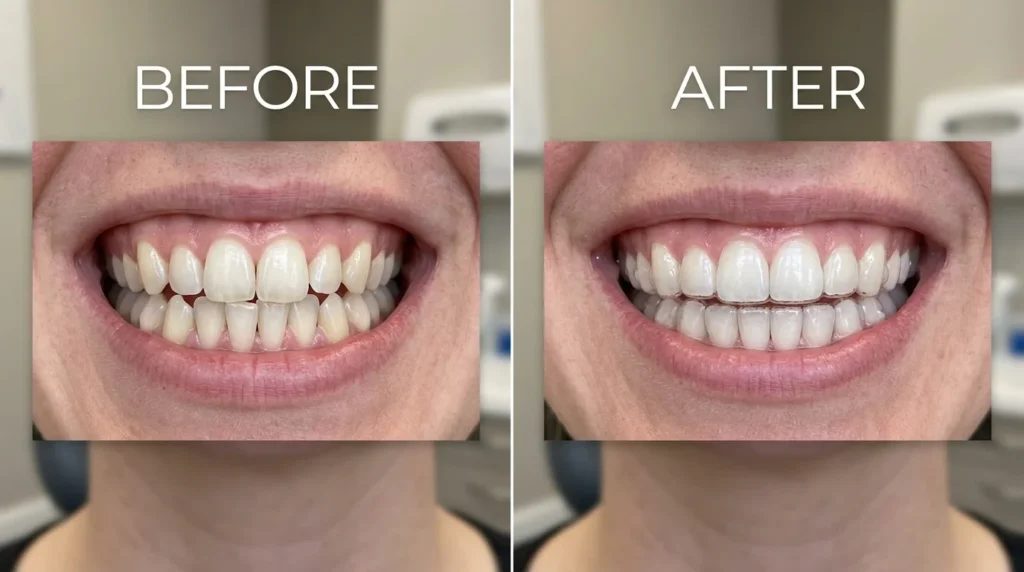
5. Veneers
Veneers can make mildly crooked, uneven or irregularly shaped teeth appear straighter and more uniform. However, veneers do not actually straighten the teeth.
A veneer is placed over the front surface of a tooth to change its shape, size, colour or appearance. They may be considered when the main concern is cosmetic rather than a significant orthodontic problem.
Veneers may be suitable for certain patients who have:
- Mildly uneven-looking teeth
- Small spaces
- Chipped teeth
- Discoloured teeth
- Irregular tooth shapes
Veneers are not a substitute for orthodontic treatment when teeth need to be physically moved or the bite needs correction. Learn more about veneers and cosmetic dentistry.
6. Composite Bonding
Composite bonding is another cosmetic option for improving the appearance of slightly uneven teeth. A tooth-coloured composite material is applied and shaped to change the appearance of the tooth. It may be useful for minor chips, small spaces or teeth that appear uneven.
Like veneers, bonding does not move crooked teeth.
It may be a reasonable option when the teeth are healthy and the concern is mainly their shape or appearance.
Crooked Teeth Treatment Comparison
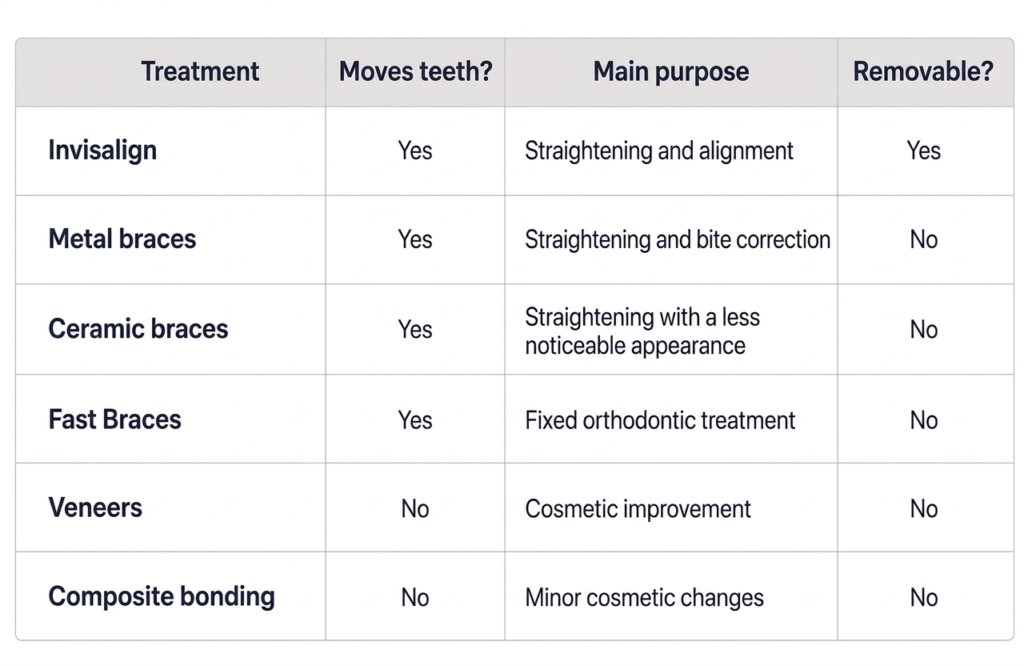
The important distinction is whether you need orthodontic tooth movement or simply want to change the appearance of your teeth.
Which Treatment Is Best for Crooked Teeth?
There is no single best treatment for every patient.
Invisalign may be suitable if:
- You want a less noticeable treatment
- You prefer removable aligners
- You want to remove your appliance while eating
- You can follow the recommended wear schedule
- Your teeth and bite are suitable for clear aligner treatment
Metal or ceramic braces may be suitable if:
- Your teeth require more comprehensive movement
- Your bite needs correction
- You prefer a fixed appliance
- You do not want to manage daily aligner wear
Fast Braces may be suitable if:
- You prefer fixed braces
- Your case is appropriate for the system
- Treatment time is an important consideration
Veneers or bonding may be suitable if:
- Your teeth are generally well positioned
- Your concern is mainly cosmetic
- You want to change the shape or appearance of individual teeth
- Significant tooth movement is not required
A dental assessment is the best way to determine which option fits your teeth and treatment goals.
Can You Fix Crooked Teeth Without Braces?
Yes. Depending on the condition of your teeth, you may be able to improve crooked teeth without traditional metal braces.
Invisalign clear aligners can move teeth without using conventional brackets and wires. For minor cosmetic concerns, veneers or composite bonding can change the appearance of teeth without moving them.
However, these treatments are not interchangeable.
If your teeth need to be physically moved, an orthodontic treatment such as Invisalign or braces may be required. If your teeth are already in a healthy position but look slightly uneven, cosmetic dentistry may be an option.
Can You Straighten Crooked Teeth Naturally?
There is no safe and reliable home method for straightening adult teeth.
Teeth should not be pushed, pulled, filed or moved using homemade devices. Attempting to move teeth without professional supervision can damage the teeth, gums or supporting bone.
Orthodontic treatment uses controlled forces and professional planning to move teeth gradually and safely.
Can Adults Fix Crooked Teeth?
Yes. Adults can have orthodontic treatment to improve crooked, crowded or misaligned teeth.
The Canadian Dental Association states that people of any age can benefit from orthodontic treatment.
Adults may choose treatment because:
- Their teeth have become crowded over time
- Their previous orthodontic results have relapsed
- They did not have braces as a child
- Their bite causes discomfort or difficulty chewing
- They want to improve the appearance of their smile
- They want to make cleaning between their teeth easier
Before treatment, your dentist should check your teeth and gums to make sure they are healthy enough for the planned treatment.
How Long Does It Take to Fix Crooked Teeth?
Treatment time depends on the amount and type of tooth movement required.
Factors that can affect treatment time include:
- The amount of crowding
- Tooth rotations
- Spacing
- Bite problems
- The number of teeth being treated
- The type of treatment
- How well you follow treatment instructions
Some Invisalign patients may begin seeing changes within several months, while complete treatment can take longer depending on the case.
Braces and other orthodontic treatments can also take several months or longer. Your dentist can provide a more accurate estimate after examining your teeth.
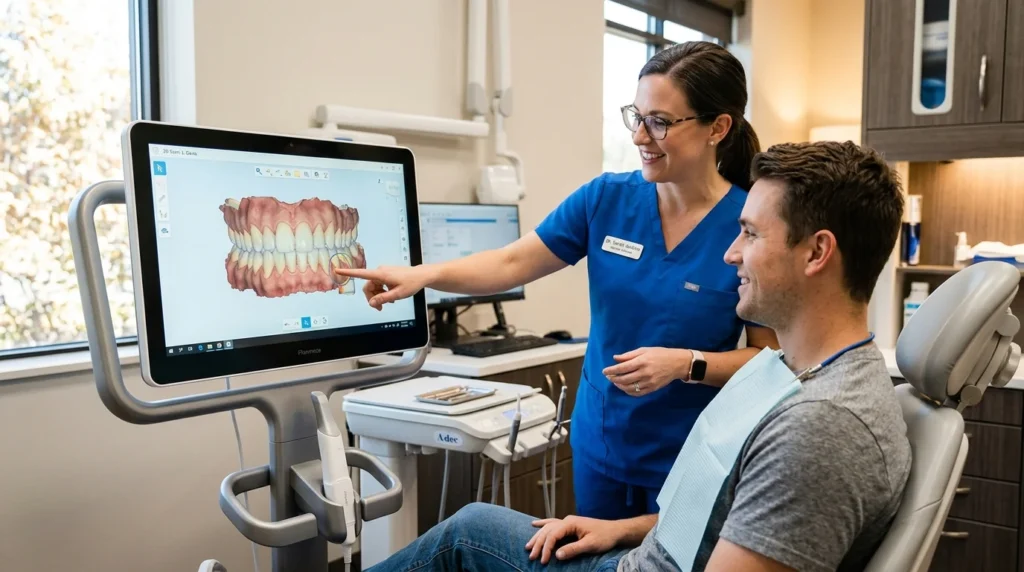
What Happens During a Crooked Teeth Consultation?
Your first appointment is an important part of choosing the right treatment.
At Olive Tree Dental, your dentist can assess:
- The position of your teeth
- The amount of crowding or spacing
- Your bite
- The condition of your teeth and gums
- Any existing dental problems
- Your treatment goals
Depending on your situation, dental photographs, scans or X-rays may also be needed.
The goal is not simply to make the teeth look straighter. Treatment should be planned around your overall oral health, tooth position and bite.
How Much Does It Cost to Fix Crooked Teeth in Canada?
The cost of fixing crooked teeth varies from patient to patient.
Your total cost may depend on:
- The treatment you choose
- The severity of the crowding or misalignment
- Whether your bite needs correction
- The expected treatment length
- The number of teeth involved
- Follow-up appointments
- Retainers after treatment
Invisalign, braces, Fast Braces, veneers and bonding all have different costs, so there is no single price for fixing crooked teeth.
Your dentist can provide a personalized treatment plan and explain the cost before you begin.
If you have dental insurance, check whether your plan provides orthodontic or other applicable dental benefits
Does Fixing Crooked Teeth Hurt?
Orthodontic treatment can cause temporary pressure, tenderness or soreness, particularly when you first begin treatment or after adjustments. This discomfort is generally temporary.
Clear aligners can also cause some pressure as they move the teeth. With braces, you may notice tenderness after an adjustment. Your dentist can explain what to expect and how to manage temporary discomfort during treatment.
Do Crooked Teeth Come Back After Treatment?
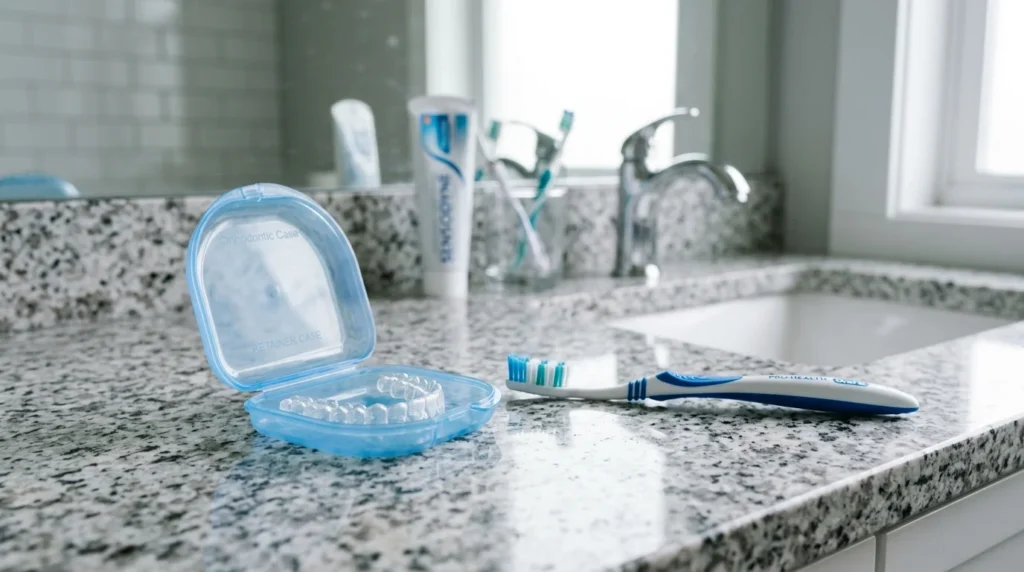
Teeth can shift after orthodontic treatment. This is why retainers are an important part of maintaining your results. Your dentist will recommend a retention plan based on your treatment and individual needs.
Wearing your retainer as instructed can help keep your teeth in their new positions.
If your teeth have become slightly crooked again after previous braces or aligner treatment, a dental assessment can determine whether you need a new retainer, minor orthodontic treatment or another option.
Frequently Asked Questions
Yes. Depending on the condition of your teeth and bite, crooked teeth may be treated with Invisalign, braces, Fast Braces or, for certain cosmetic concerns, veneers or composite bonding.
There is no single fastest treatment for everyone. Treatment time depends on the amount of tooth movement required and the treatment selected. Some suitable cases may be completed faster than others, but your dentist needs to assess your teeth before estimating treatment time.
Invisalign can treat many types of crooked and crowded teeth. Whether it is appropriate depends on your individual tooth position and bite. A dental assessment is needed to determine whether clear aligners are suitable for you.Veneers and bonding can cause mild sensitivity for a few days. Over-the-counter pain relief is enough for most people.
Neither option is automatically better for every patient. Braces and Invisalign can both straighten teeth, but the most suitable option depends on the type of movement required, your bite, your preferences and your ability to follow treatment instructions.
Veneers can make mildly crooked or uneven teeth look straighter, but they do not move the teeth. Significant crowding or bite problems may require orthodontic treatment instead.
Composite bonding can improve the appearance of slightly uneven teeth, small spaces or chipped teeth. It does not physically straighten or move crooked teeth.
Yes. Adults can receive orthodontic treatment. The Canadian Dental Association states that orthodontic treatment can benefit people of any age.
Treatment time varies according to the complexity of the case and the treatment used. Your dentist can provide a more accurate estimate after examining your teeth and bite.
There is no fixed price because treatment costs vary according to the treatment type, complexity, treatment length and individual needs. Olive Tree Dental can provide a personalised estimate after your assessment.
No reliable home method can safely straighten adult teeth. Teeth that need to be moved should be treated using professionally planned orthodontic treatment.
They can. Teeth naturally have some tendency to shift after orthodontic treatment, which is why wearing retainers is important for maintaining your results.
Ready to Fix Crooked Teeth?
If crooked, crowded or uneven teeth are affecting your smile or making it harder to maintain your oral health, Olive Tree Dental can assess your teeth and discuss the treatment options available.
Book a consultation at Olive Tree Dental in London, Ontario to find out which option may be right for your smile.